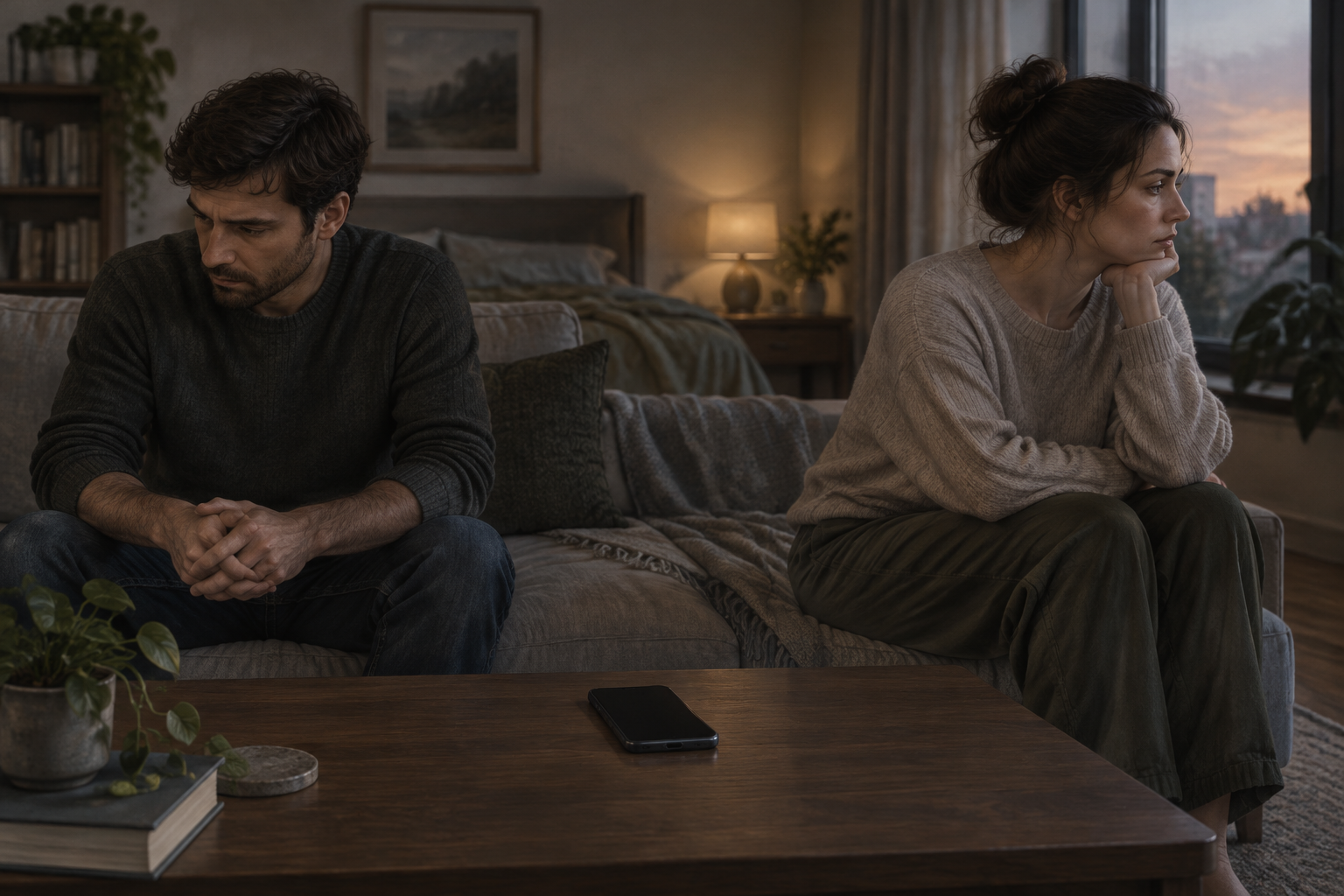
A fictionalized relationship dilemma.
We had been married for four years when I discovered my wife’s affair. I decided to try to stay. Ten months later, I was still looking for evidence that the relationship with the other man had ended.
I secretly recorded her in the car. That was a serious intrusion, not a healthy method of rebuilding trust. It also failed to produce the certainty I had imagined. What I heard raised more questions about voice messages and conversations whose context I did not know.
When I asked her about them, she said she could not remember whom she had been speaking to and that she deleted voice notes. I found those answers difficult to accept. I also recognized that we were now living in a marriage where one person concealed a recording and the other could not provide explanations the first believed.
I had treated choosing to stay as though it were the same thing as having a workable reconciliation. We had not clearly agreed what ending the affair required, what honesty would look like afterward, or what we would do if one of us no longer wanted the marriage.
The next decision could not sensibly depend on obtaining one more private recording. I needed to stop the surveillance and decide whether direct answers, agreed boundaries, and possibly professional support could make continuing acceptable to both of us.
I still loved her. I was also exhausted. Those feelings could exist together without either one answering the question of whether the relationship could continue.
What I could no longer call trust was the hope that enough checking would eventually allow me to stop checking.